Hazard-Family Reference
Every balloon color in a study selects one hazard family and its parameters. A family defines the per-pump conditional hazard
where \(N\) is the color’s max_pumps cap. From the hazard vector the engine
derives the survival curve \(S(s) = \prod_{k=1}^{s}(1 - h(k))\) and the
expected value of stopping at \(s\), \(\mathrm{EV}(s) = r \cdot s \cdot S(s)\)
(with \(r\) the reward per pump). Hazards are clamped to \([0, 1]\); parameters
are validated by the configuration layer before a study can run.
Because arbitrary hazards have no closed-form optimum, the EV-optimal stop \(s^*\) is found numerically — a full scan of \(\mathrm{EV}(s)\) over \(1 \le s \le N\), taking the smallest \(s\) on ties. The reward \(r\) scales the EV curve uniformly and never moves \(s^*\). For the default linear (dynamic-hazard) study this reproduces the classic \(11/5/2\) optima and the \(\sqrt{N}\) approximation.
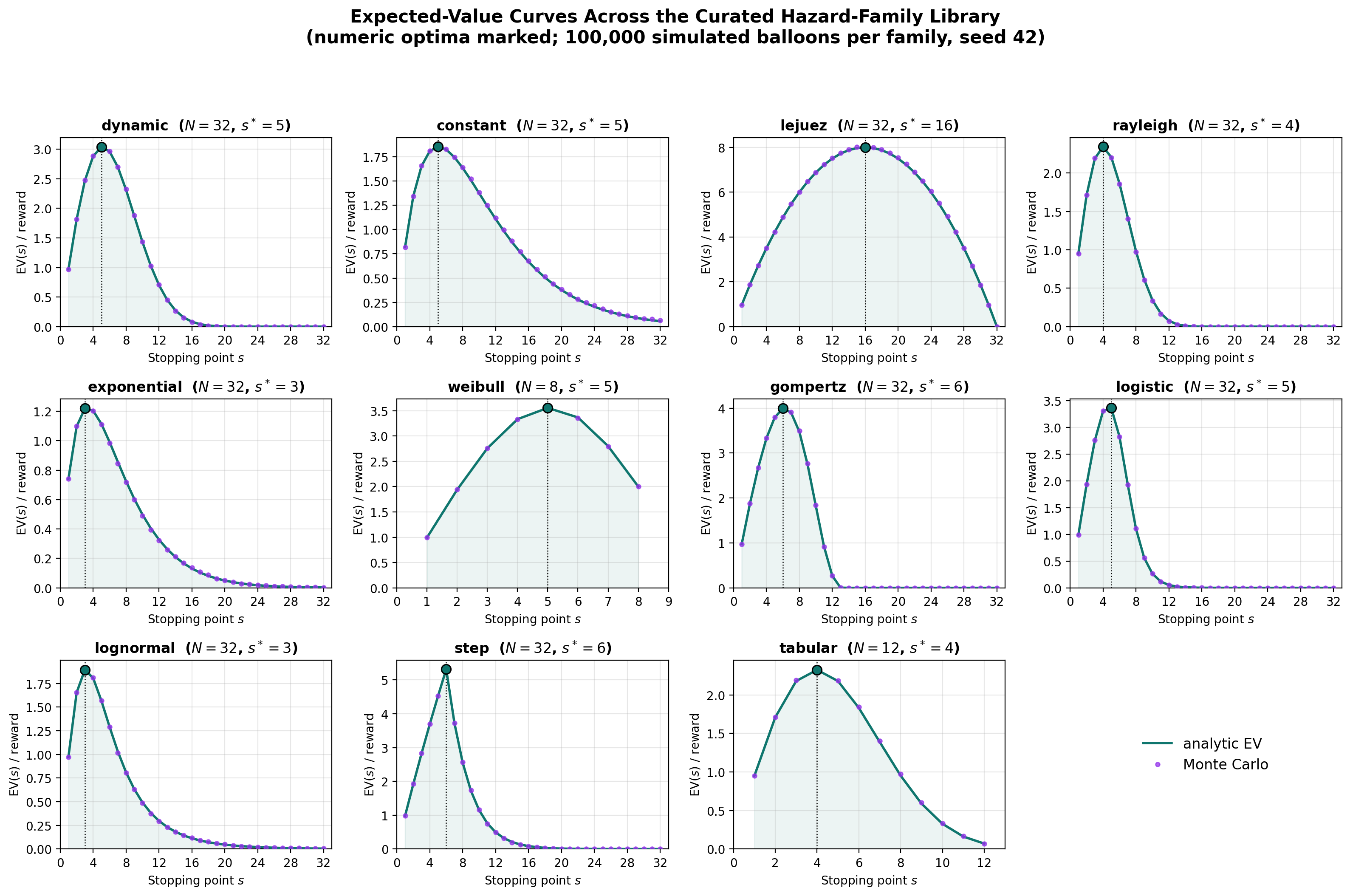
Expected-value curves for a representative parameterization of each family
(unit reward). The dot marks the numeric optimum \(s^*\); the overlaid points
are seeded Monte Carlo estimates. Regenerate with
python scripts/plot_hazard_families.py.
Simulation-verified optima
The numeric optima are confirmed by independent Monte Carlo simulation — balloons are burst directly from the hazard vector and the EV curve is rebuilt empirically, sharing nothing with the analytic path but the hazards themselves:
python -m scoring.verification
prints a per-family PASS table (100,000 simulated balloons per family,
seeded). The same check runs in the test suite (tests/test_verification.py),
so the claim cannot silently rot as families evolve.
The families
dynamic — linear hazard (the flagship)
The paradigm the instrument is named for: hazard grows with every pump, burst-time is approximately Rayleigh, and the optimum sits near \(\sqrt{N}\) — a reachable target that separates calibrated from indiscriminate play. No parameters; the risk profile is set entirely by the cap \(N\).
constant — flat per-pump probability
Burst-time is geometric; the EV-optimum is approximately \(1/p\) (the continuous optimum is \(-1/\ln(1-p)\)).
Parameter |
Constraint |
Meaning |
|---|---|---|
|
\(0 < p < 1\) |
per-pump burst probability |
lejuez — classic uniform BART
The original Lejuez et al. (2002) model: the burst point is uniform on \(\{1..N\}\), survival is \((N - s)/N\), and the optimum sits at \(N/2\). Use it to run traditional baselines or replicate classic studies on the same instrument. No parameters.
rayleigh — linear hazard with an explicit scale
Equivalent to the dynamic family with an effective \(N = \sigma^2\), decoupling the hazard’s slope from the color’s cap; the optimum is approximately \(\sigma\).
Parameter |
Constraint |
Meaning |
|---|---|---|
|
\(\sigma > 0\) |
Rayleigh scale; optimum \(\approx \sigma\) |
exponential — memoryless burst-time
A flat hazard expressed through a rate: burst-time is geometric and the optimum is approximately \(1/\lambda\).
Parameter |
Constraint |
Meaning |
|---|---|---|
|
\(\lambda > 0\) |
hazard rate |
weibull — tunable rising or falling hazard
The scale is tied to the cap \(N\); the shape \(m\) tunes the profile: \(m < 1\) decreasing, \(m = 1\) flat, \(m = 2\) linearly rising, \(m > 2\) accelerating. Note the hazard magnitude is \(O(1/N)\), so large caps produce gentle, flat EV peaks.
Parameter |
Constraint |
Meaning |
|---|---|---|
|
\(m > 0\) |
Weibull shape |
gompertz — exponentially accelerating hazard
Risk compounds sharply late in the balloon — a “cliff” that punishes overshooting harder than the linear model.
Parameter |
Constraint |
Meaning |
|---|---|---|
|
\(a > 0\) |
baseline hazard scale |
|
\(b > 0\) |
exponential growth rate |
logistic — safe-then-ramp S-curve
Hazard stays low through an initial safe zone, then ramps toward a ceiling — useful for designs with an explicit “point of no return”.
Parameter |
Constraint |
Meaning |
|---|---|---|
|
\(0 < h_{\max} \le 1\) |
asymptotic hazard ceiling |
|
\(k_0 > 0\) |
pump at which hazard is \(h_{\max}/2\) |
|
\(r_s > 0\) |
logistic slope |
lognormal — rise-then-fall (non-monotone)
The hazard of a log-normal burst time, \(h(k) = f(k)/S(k)\): it rises to a mode and then falls, so surviving deep into a balloon genuinely signals safety. Computed with the standard library (no scipy).
Parameter |
Constraint |
Meaning |
|---|---|---|
|
— |
log-scale location |
|
\(\sigma > 0\) |
log-scale shape |
step — piecewise-constant hazard
levels[i] applies on the segment delimited by ascending breakpoints
(segment 0 runs up to and including the first breakpoint). Encodes discrete
regime changes: calm, then dangerous.
Parameter |
Constraint |
Meaning |
|---|---|---|
|
≥ 1 strictly ascending positive pump counts |
segment boundaries |
|
≥ 2 values in \([0, 1]\), |
hazard per segment |
tabular — explicit hazard vector (the escape hatch)
values[k-1] \(= h(k)\), given directly as data — no formula at all. The
vector’s length must equal the color’s cap \(N\) exactly, and every value must
lie in \([0, 1]\). Use it to reproduce a hazard schedule from another study’s
materials when no parametric family fits.
Parameter |
Constraint |
Meaning |
|---|---|---|
|
length \(= N\), each in \([0, 1]\) |
per-pump hazards |
Choosing a family
Replicating the classic BART?
lejuez.Want calibration sensitivity (the instrument’s purpose)?
dynamic, orrayleighwhen the hazard slope should not depend on the cap.Simple stochastic baseline?
constant/exponential.Late-risk designs?
gompertz(smooth) orlogistic/step(thresholded).A published hazard schedule?
tabular.
Study files (study.json) name a family and its parameters — never code —
and the configuration layer rejects invalid parameters with structured
errors before a session can start.